

Rutgers School of Nursing–Camden is using new immersive simulations to help nursing students build clinical judgment, confidence, and decision-making skills before entering patient care settings.
A nursing student enters a patient room, assesses symptoms, makes treatment decisions, and responds to a rapidly changing medical situation. The patient may be virtual, but the clinical judgment required is very real. Through a new virtual reality (VR) clinical training program at Rutgers School of Nursing–Camden, students are gaining immersive experience that strengthens critical thinking, decision-making, and confidence before they enter real-world healthcare settings.

“We have been researching the potential uses of VR since 2020,” said Kevin Emmons, associate dean for clinical and external affairs and a clinical professor with Rutgers School of Nursing–Camden. “We ran many trials with both faculty and students to see whether the technology could create meaningful learning opportunities. What we found was clear: VR is an excellent way for students to build their critical thinking and decision-making skills.”
That early research into using VR in the classroom led to a new clinical program, made possible through a collaboration with Johnson & Johnson, whose longstanding commitment to healthcare education and workforce development aligns with Rutgers–Camden’s mission to prepare the next generation of nurses.
“Our team worked closely with representatives from Johnson & Johnson to develop and submit a proposal outlining plans to enhance simulation-based education and student support,” Emmons said. “The result was a funding award from J&J to expand the school’s simulation center, adding virtual reality and other innovative teaching technologies, as well as scholarships for nursing students.”
The new VR clinical is not intended to replace traditional clinical experiences or hands-on skills training; rather, it offers a powerful complement to both. The technology gives students opportunities to strengthen critical thinking, clinical judgment, and decision-making in realistic patient-care scenarios while building confidence through independent practice. Unlike team-based simulations, where responsibilities may be divided among participants, VR requires each student to take an active role in patient assessment, care, and decision-making. It also allows multiple students to train simultaneously, expanding access to simulation experiences, simplifying scheduling, and ensuring a consistent learning experience across the program.
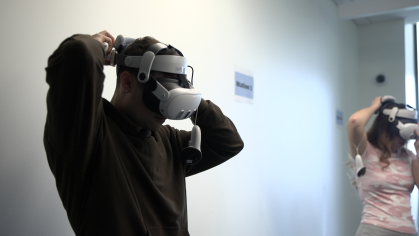
“A key part of this process is aligning every VR experience with the clinical objectives students are expected to meet,” Emmons said. “Because the experiences are tied directly to those objectives, we can measure how well students are meeting them. This gives us a clear, consistent way to confirm that students are gaining the knowledge and decision-making skills the program is designed to build.”
Beyond strengthening clinical decision-making, the VR program helps students develop the interpersonal skills essential to patient care. Through realistic patient interactions, students practice therapeutic communication, empathy, and rapport-building in a safe environment. The technology also lets them experience rare but high-risk clinical scenarios they may never encounter during traditional training, helping build the confidence and judgment needed to respond effectively in critical situations.

By providing standardized practice and detailed performance feedback, VR programs like Rutgers–Camden’s can help transform nursing education while complementing—not replacing—hands-on clinical experiences. The technology enables students to learn from mistakes, refine clinical reasoning, and receive personalized guidance, supporting a more confident, practice-ready nursing workforce.
“This program reflects the school's broader commitment to preparing students for the realities of modern healthcare, and the partnership with Johnson & Johnson helps make that innovation possible,” said Emmons. “VR is one part of a larger investment in the simulation lab, with the goal always being the same: to graduate confident, well-prepared nurses ready to serve their communities.”