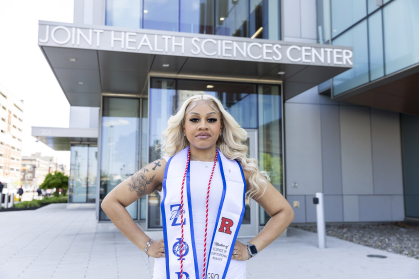
Inspired by Family and Driven by Research, Computational and Integrative Biology Graduate Zion Harris Earns Master’s Degree at Rutgers–Camden

Raised by two social workers who earned master's degrees and instilled in her the value of education, Zion Harris followed in her parents' footsteps but forged a new path in STEM.
This month, the northeast Philadelphia native will earn a graduate degree in computational and integrative biology at Rutgers University–Camden. She will continue her academic journey here this fall as she pursues a Ph.D.
As a master's student at The Center for Computational and Integrative Biology (CCIB), Harris has conducted award-winning research that uses epidemiological modeling to monitor human papillomavirus (HPV)-related cancers across New Jersey, supporting public health officials and policymakers in improving vaccination strategies and outreach efforts for HPV prevention.
Harris grew interested in the intersection of the sciences and public health soon after earning her computer science degree at Lincoln University, discovering she had little interest in a software engineering career. She later interned at the Penn State College of Medicine, where she was part of a data study surveilling pregnancies and mental health during the COVID-19 pandemic. She found the work fascinating.

"I loved that research. I thought, 'How do I get into that field?' If I can combine computer science, biology, and public health, then that's what I should do," Harris said. "That's what motivated me to get a graduate degree."
Not many colleges and universities offer computational biology programs, Harris said, making Rutgers–Camden's Center for Computational and Integrative Biology even more appealing because it was also close to home.
She had been accepted to and visited several graduate schools, including an Ivy League institution. But it all clicked for her at an Admitted Students Day held by CCIB.
"I wanted to feel like my work mattered, where I wasn't just another research assistant. And I wanted a principal investigator (PI) who was committed to mentoring me. I found that on my first day at the Joint Health Sciences Center," Harris said. "I just felt that warmth and the collaboration at CCIB. The moment I left Admitted Students Day, I knew I had to go here."
Under the guidance of Benedetto Piccoli, the Joseph and Loretta Lopez Chair Professor of Mathematics and Distinguished Professor in the Department of Mathematical Sciences, Harris is, through mathematical modeling and simulations, building tools that better help public health officials understand how different HPV vaccination and screening practices affect communities.
"And when I say vaccination, I mean completing the full vaccine series, because some people only get one dose, while others don't get vaccinated at all. On the screening side, we're looking at things like Pap smears and HPV-type testing, and how improving access to and participation in those practices can better support community health outcomes,” she added.
Her work has earned the 2026 Walter Rand Institute – Graduate Research Scholarship, as well as funding from the South Jersey Institute for Population Health (SJIPH) to continue her research with a local focus, where she is motivated to address HPV-related health disparities, particularly in Black and brown communities.

In addition to Piccoli, she credited Ryan Weightman, then a Ph.D. student in the Piccoli Lab and now a postdoctoral fellow at the Rutgers School of Public Health, with supporting her throughout her research and encouraging her to pursue doctoral studies, outlining all the necessary steps to apply for the Ph.D. program. After securing funding to continue her work, she began envisioning a Ph.D. for herself. "When I got the SJIPH grant, I thought, 'Ok, I really can get a Ph.D.' This is possible. I think I can do this," she said.
Beyond the lab, Harris has built firm roots on the Rutgers–Camden campus. She works as a graduate program coordinator in the Office of Housing and Residence Life, overseeing the Camden Apartments and their resident assistants.
She also serves as secretary of the Graduate Student Organization (GSO), which plans social and professional programs, such as a recent hiking excursion and a hiring event that brought area companies to campus. "We want to make sure that people who are on campus as well as people who are commuters feel a sense of home, especially since graduate school can sometimes feel isolating," she said.
Harris’s own graduate school experience was not without bouts of isolating doubt, a previously crippling commute, and moments of imposter syndrome. Completing the journey means the world both to her and her family.
"My parents were the first people in their families to get graduate degrees. Education is very important in my family and a pillar in our discipline. So, this is also owed to my family, and to show that you can do this, especially to my siblings. I'm the oldest out of four, so this is to show my siblings, yes, not only can you get a bachelor’s, but you can also get a graduate degree,” she said. “It means so much to me just to get a master's, but especially from Rutgers–Camden. I love this community.”