Researchers and community organizations from across South Jersey shared findings from a variety of studies exploring health disparities and discussed opportunities to improve well-being throughout the region.
From investigating lead contamination in Camden's stormwater to improving asthma care for children and addressing the lasting effects of gun violence, researchers and community organizations across South Jersey are working together to tackle some of the region's most pressing health challenges.
Their work was highlighted at an event marking the release of the South Jersey Institute for Population Health's (SJIPH) 2026 Impact Report, which showcases collaborative research conducted by Rutgers University–Camden, Rowan University, and community partners across southern New Jersey.
Established in 2021 through a partnership between Rutgers–Camden and Rowan University, with support from the Rowan University/Rutgers–Camden Board of Governors, SJIPH connects academic researchers with community organizations to address health challenges across South Jersey's seven counties.

“Strong community-engaged research begins by listening,” said Thomas Risch, vice chancellor for research at Rutgers–Camden. “These partnerships make our research stronger and help us ask the right questions that matter locally. The Institute demonstrates how universities can advance knowledge while serving the region we call home.”
Nicole A. Vaughn, associate professor of public health in the Department of Health and Exercise at Rowan University and SJIPH faculty co-lead, echoed the importance of community participation in shaping research priorities.
“When we listen to communities and take the time to understand the challenges they face, we can develop research projects that respond to their needs and lead to meaningful results,” Vaughn said.
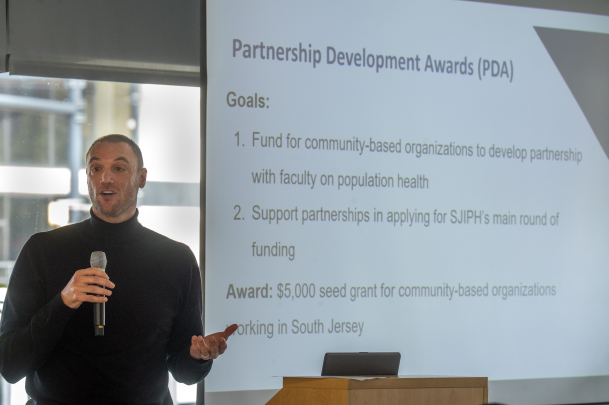
Since its founding, SJIPH has awarded more than $1.3 million to support more than 50 collaborative research projects with the potential to inform public policy, strengthen community programs, and improve health outcomes.
The 2026 Impact Report highlights 10 projects and includes plain-language explanations, definitions of research terms, and QR codes linking to additional information, making the findings and their potential applications more accessible to community members, practitioners, and policymakers.
"The collaborative research projects highlighted in this report focus on health outcomes specific to our region and will equip policymakers and community stakeholders with the insight they need to meet these issues head-on," said Jeffrey L. Nash, commissioner of the Camden County Board of Commissioners and CEO of the Rowan University/Rutgers–Camden Board of Governors.

Keynote speaker Sharrelle Barber, a social epidemiologist at Drexel University and founder and director of its Ubuntu Center, emphasized the importance of translating research into action. Drawing on her work in the United States and Brazil, Barber illustrated how partnerships among researchers, residents, and community advocates can identify inequities, advance policy reforms, and improve access to health care. She stressed that successful partnerships require trust, shared decision-making, and respect for community expertise.
“Too often, the people who are in the rooms where decisions are being made have not listened to the community’s concerns, and that lack of knowledge shows up in the research or policy that flows from those meetings,” said Barber. “Genuine, impactful solutions only come when we get out of our silos, welcome more voices to the table, and together begin to pull back the layers, so collectively we can begin to understand what is happening.”
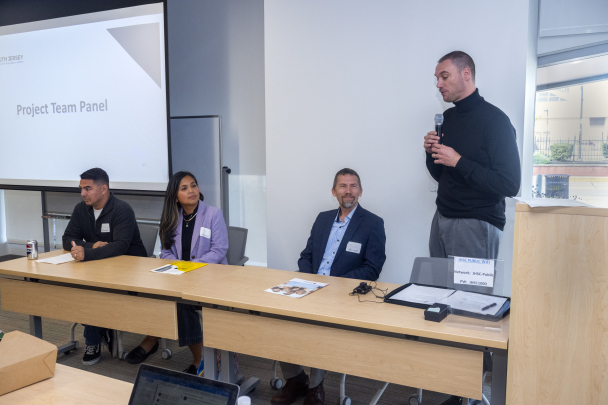
Following the keynote, Stephen Danley, professor of public policy and administration, director of the Center for Urban Research and Education at Rutgers–Camden, and SJIPH faculty co-lead, moderated a panel featuring researchers and community partners involved in three of the report's 10 projects.
The projects included an assessment of physical and mental health disparities among Filipino American women in South Jersey; an evaluation of the effect of placing a trained social worker within the Millville Police Department to assist with mental health and substance use crises; and an examination of how family advocates help address social factors affecting health and barriers to essential services.
Panelists discussed their findings, research challenges, and opportunities to translate their work into improvements in community health.

In his closing remarks, Michael Hayes, associate professor of public policy at Rutgers–Camden and a member of the SJIPH advisory committee, emphasized that improving community health requires looking beyond medical care to factors such as housing, education, and economic opportunity. He also urged researchers to measure success not only through academic publications, but through findings that help communities strengthen programs, inform policy, and improve lives.
“The goal isn't simply to produce research. It's to produce knowledge that people can use—knowledge that can improve a program, improve practice, and ultimately, hopefully, improve people's lives,” said Hayes.
The SJIPH 2026 Impact Report Roll Out